Why Most Sales Transformations Fail Before They Begin
Most sales team transformation efforts fail not because of the wrong technology, but because of the approach.
The biggest trap I’ve seen in sales transformation is treating a sales culture problem as a process problem. A new CRM, for example, doesn’t create accountability. AI Software, despite what most advertisements suggest, doesn’t build pipeline discipline. New hires — without a clear sales execution framework — don’t perform.
Sales teams in traditional industries — insurance, financial services, manufacturing, retail distribution — carry institutional memory. When another transformation program “washes out,” it doesn’t just drain budget; it erodes trust, kills initiative, and makes future improvements exponentially harder to land.
Predictable revenue growth isn’t a technology outcome — it’s a leadership outcome. And it begins by understanding exactly where your sales team’s time is being spent.
The 25/75 Rule: Escaping the ‘Sales Hustle’ Trap
Your sales reps aren’t underperforming — they’re underwater, spending only about 20% of their working week in actual selling conversations while the other 75% disappears into administrative burden.
That 75% is what the Unstoppable Sales™ framework calls sales admin burden — the low-value, high-friction work that erodes your team’s capacity to do the one thing that actually moves the revenue needle: human-to-human conversation. CRM updates, internal reporting, chasing approvals, creating prospecting resources — none of it creates a deal; it just consumes the time that should.
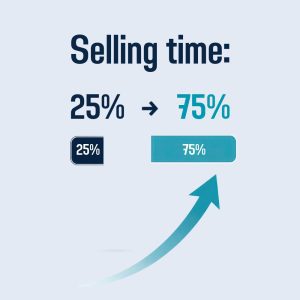 The shift from 25% to 75% active selling time isn’t a motivational target. It’s an operational design problem. And it won’t be solved by pushing reps harder or adding another workflow tool. It requires deliberate systems decisions at the leadership level — decisions about where AI agents absorb admin burden so your people can focus on the conversations that close.
No algorithm closes a complex deal.
No automation builds the kind of peer-level trust that moves a seven-figure deal across the line.
Intentional and effective human interaction remains the only irreplaceable activity in the sales process. When you reclaim selling time, you’re not just improving efficiency — you’re investing directly in the conversations that compound into predictable revenue growth.
This is also where sales team coaching becomes a structural advantage, not a line item. Research shows that leaders who equip their teams with clear frameworks and eliminate friction from their day dramatically improve output — not by demanding more activity, but by designing better conditions for the right activity. AI agents, used intentionally, act as the bridge between where most sales teams operate today and where they need to be.
The question that follows is who does that designing — and that’s where the leader’s role needs to fundamentally shift.
The Leader as Designer: A New Framework for 2026 and Beyond
The top-performing sales leaders in 2026 don’t win by out-hustling their teams — they win by designing the conditions that make their teams unstoppable.
A leader who operates as a “super-rep” — the one who jumps on every call, rescues every stalled deal, and lives in the CRM pulling reports — is actually limiting team output, not amplifying it, because the moment that leader steps back, performance drops. And sales team performance metrics that depend on the leader’s personal activity are fragile by definition.
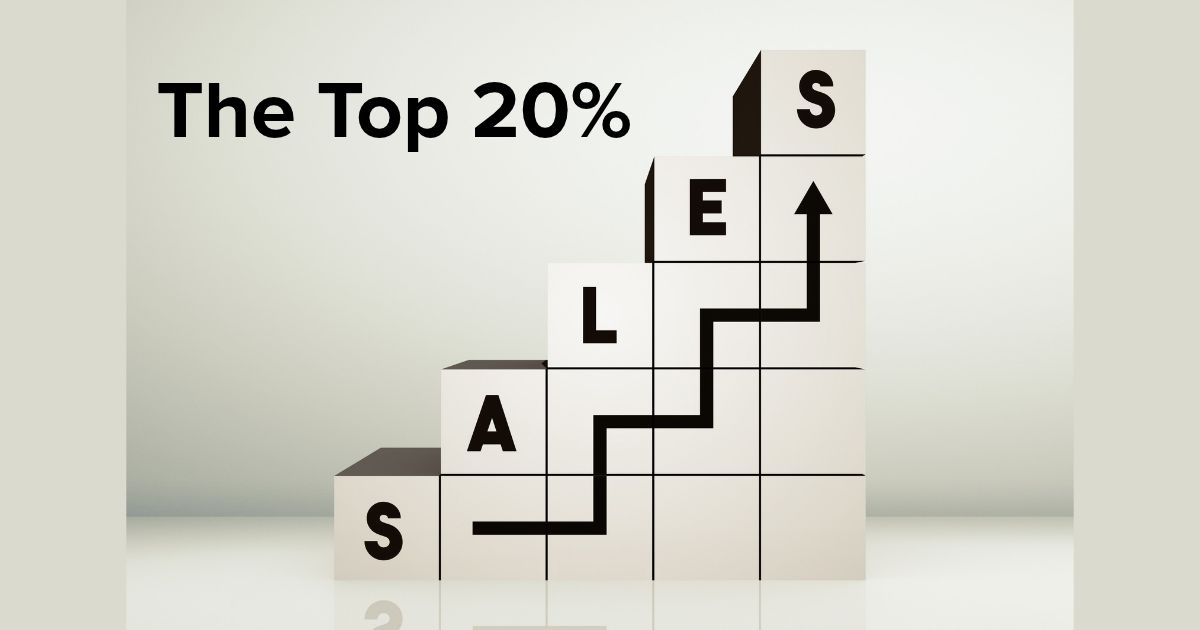
The shift that separates the top 20% is a move from execution to architecture.
That means the leader is responsible for three specific design decisions:
- What commitments the organization can actually deliver
- How internal flexibility on pricing and terms gets accessed by the sales force, and
- Where executive weight gets deployed to accelerate peer-to-peer alignment.
These aren’t tactical decisions — they’re structural ones that shape every conversation a rep has in the field.
When leaders use their organizational access to align internal stakeholders—operations, finance, product—before a deal closes, they remove the friction that kills momentum at the finish line. Research shows that great sales leaders build internal clarity so reps can sell with confidence, not constantly escalate for approvals. And 82% of sellers report confidence in their company’s 12-month growth strategy when leaders provide that kind of clear, consistent direction — a figure that underscores just how directly leadership design translates into rep-level performance.
That clarity is the real multiplier. And it raises a bigger question: once you’ve designed the right conditions, how do you equip your team to operate at the level those conditions demand?
Upskilling for the AI Era: Beyond the Hype
AI upskilling isn’t a cost-cutting measure dressed up in tech language — it’s a direct revenue multiplier that separates teams stuck in mediocre metrics from those executing at full capacity.
The data makes this impossible to ignore. Sales teams that actively upskill around AI are 2.4x more likely to achieve strong revenue growth, and 81% of AI-adopting sales teams report measurable profit surges. Those aren’t adoption statistics — they’re performance outcomes. And they don’t happen because a team bought a new tool. They happen because leaders invested in structured sales team training that taught reps how to use AI intentionally, at every stage of the pipeline.
Sales teams that upskill around AI are 2.4x more likely to achieve strong revenue growth — not because the technology is superior, but because the people using it are better equipped to focus on their behaviors that close deals: high-fidelity human conversation.
In practice, this means training reps to offload prospecting research, outreach sequencing, and pre-call prep to AI — so that when they’re in front of a buyer, they’re fully present and prepared to move the conversation forward.
Leaders who design this shift see a compounding effect: teams execute at higher volume and higher quality because the cognitive load of low-value work no longer competes with the mental energy required to close. That’s the operating condition that makes performance predictable.
The Bottom Line: Key Takeaways for Sales Leaders
The difference between the top 20% and everyone else isn’t talent — it’s the disciplined application of four interconnected principles that compound over time.
Here’s the reality: transformation doesn’t happen at the software level. It happens at the leadership level.
Here’s what this looks like in practice:
- Shift from super-rep to designer. Stop being the person who rescues every deal and start building the environment where your reps don’t need rescuing. Your highest-leverage contribution is structural, not tactical.
- Automate sales admin burden to reclaim selling time. When reps spend most of their day on administrative work, no amount of motivation closes the gap. Redirect that time toward high-value, human-to-human conversations — where revenue is actually created.
- Prioritize AI upskilling as a revenue initiative. Teams that actively develop AI proficiency are 2.4x more likely to achieve strong revenue growth. Treat upskilling as a revenue line item, not a training expense.
 The Unstoppable Sales framework ties these principles together because none of them work in isolation.
- Design without the right people stalls.
- Upskilling without automation relief gets absorbed by toil.
- Curiosity without structure goes nowhere.
When a leader connects these areas — deliberately, sequentially — what follows isn’t incremental improvement. It’s a team that executes at a level your competitors can’t easily replicate.
That’s not a theory. It’s what a sales culture built to last actually looks like.
Building an Unstoppable Sales Culture in 2026
Transformation isn’t a software update you deploy on a Tuesday — it’s a deliberate leadership decision to address the conditions that keep your team stuck.
Every principle covered in this article points to the same conclusion: the gap between teams that execute predictably and teams that plateau isn’t found in a dashboard. It’s found in the willingness to redesign how selling actually happens. How much of your team’s day is spent in genuine selling conversations? How much is absorbed by administrative toil that no buyer ever sees or benefits from?
That question isn’t rhetorical. It’s the starting point for every zero-fluff, actionable shift that compounds into a high-performing sales culture. Organizations that move through this process — reclaiming selling time, upskilling around AI, hiring for curiosity, leading with design — build something competitors can’t easily replicate. That durability is exactly what the Unstoppable Sales™ framework is built to create.
A well-structured sales kickoff or keynote is often where the mindset shift begins in practice. It creates alignment, surfaces gaps leadership can act on, and gives your team a shared language for what high performance actually requires. It’s not inspiration for its own sake — it’s the catalyst that converts the ‘Designer’ framework from concept into execution.
As a next step, audit your team’s selling time against their admin time, identify where the design breaks down, and if appropriate, explore how Shawn Casemore’s professional speaking and sales consulting services can accelerate that shift — from unpredictable cycles to results your team can own.
© Shawn Casemore 2026. All Rights Reserved.
Share This Article
Choose Your Platform: Facebook Twitter Google Plus Linkedin