
The High Cost of a Transactional Sales Mindset
In mid-market and enterprise sales, the biggest performance killer isn’t a weak pipeline or uncompetitive pricing—it’s a mindset tied to short-term transactions rather than long-term, strategic, sustained growth.
The “hustle harder” approach that defined an earlier era of selling is collapsing under the weight of modern buyer behavior.
Today’s buyers do their own research, often with multiple stakeholders, and then expect sales professionals to arrive as informed, trusted advisors—not order-takers or presenters running through a script.
When a sales team relies on activity volume and motivational momentum alone, you get exactly what most sales leaders dread: unpredictable revenue, stalled deals, and quarters that feel like a coin flip.
A true Mind for Sales isn’t about just staying fired up through a rough patch. It’s about building the internal discipline and mental framework that makes high performance repeatable—regardless of market conditions or buyer complexity. According to Skillsoft, developing a Mind for Sales means focusing on daily habits and practical strategies for sales success, not just high-level inspiration. That distinction matters enormously for enterprise sales teams where a single misread buyer signal can cost months of pipeline.
Unpredictable sales cycles are almost always a symptom of a missing mental framework. When salespeople operate without one, they react instead of lead, chase instead of qualify, and motivate themselves with short bursts of energy that fade when deals get difficult. The result is inconsistency at scale—and inconsistency gets expensive quickly.
That’s why a Mind for Sales is a strategic asset—not a soft-skills nicety—is where the real competitive separation begins.
What It Actually Takes to Have a Mind for Sales
What is a sales mindset? It’s the belief that you control your own success—and the discipline to act on that belief every single day regardless of barriers, obstacles or delays that might present themselves.
That definition matters because it shifts the conversation away from tactics and scripts toward something more durable and long-term. The components of a strong sales mindset include knowing you’re ultimately in control of your results and maintaining an optimistic outlook—even when the pipeline goes dry, or a deal falls through at the eleventh hour—both necessary and possible. But optimism alone doesn’t close deals.
Three foundational skills turn mindset into measurable performance:
Empathy: Empathy helps you to relate to your prospect, understanding their true decision-drivers.
Discipline: Discipline, on the other hand, keeps your prospecting consistent when motivation dips.
Focus: And focus—remaining consistently focused on what’s next, and where you might take the conversation and opportunity.
These three skills are what separate a trusted advisor from a typical salesperson.
Underneath those skills, you’ll find what Shawn Casemore refers to as the 5 C’s: Character, Competence, Confidence, Connection, and Conviction. These aren’t abstract ideals. They’re the operating principles that determine how a buyer perceives you from the first conversation forward. Aligning your team around frameworks like these creates a shared sales language—so every rep is building relationships through the same lens, not improvising differently every call.
There’s also a motivator question worth addressing directly. Commission structures and quota pressure can drive short-term activity, but they’re unreliable fuel for a long career and motivation in sales. The only sustainable motivator is a genuine desire to help others succeed. When that’s the driver, follow-up feels natural, objections feel like information, and rejection doesn’t erode your confidence over time.
Lastly, being a high-performing sales professional isn’t something you switch on when you need it—it requires consistently protecting your focus, guarding your energy, and setting goals that pull you forward rather than just tracking what’s already happened.
The 7 Rules of Sales for the Modern Leader
To improve sales performance in a lasting, predictable way, modern sales leaders need more than tactics—they need a set of operating principles that hold up under pressure, across industries, and through every stage of the sales cycle.
As the Institute of Sales Professionals notes, “sales starts in the mind”—and that truth sits at the core of every rule below. These aren’t scripts. They’re the mental operating standards that separate professionals who build predictable revenue from those who constantly chase it.
- Focus on the buyer’s outcome, not a quota. Quota is a lagging indicator. The moment a buyer senses you’re selling to hit a number rather than solve their problem, trust collapses. Start every conversation by asking what success looks like for them.
- Integrity in prospecting is non-negotiable. Generic outreach at scale erodes your credibility before the first conversation starts. If you’re struggling to get past early gatekeepers, the issue is usually a lack of relevance—not persistence.
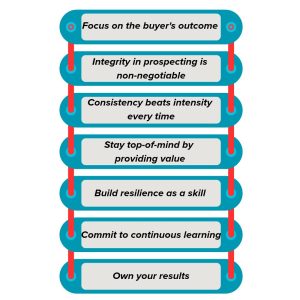 Consistency beats intensity every time. A sprint of outreach followed by weeks of silence creates unpredictable pipelines. Daily, deliberate action compounds over weeks and months, resulting in a steady flow of qualified opportunities.
- Stay top-of-mind by providing value, not just “checking in.” A follow-up email that offers a relevant insight, a case study, or a pointed question earns attention. A generic check-in gets deleted (so no more “Just Following Up!”)
- Build resilience as a skill, not a personality trait. Rejection is data. Each no that doesn’t break your momentum sharpens your process and qualifies your pipeline.
- Commit to continuous learning. The buyer has changed. Digital-first behavior, compressed timelines, and more informed prospects demand that you keep developing—not just in product knowledge, but in how you sell.
- Own your results. Blame is the enemy of growth. High-performing sales professionals treat every lost deal as a learning opportunity, not a market condition.
These seven rules aren’t aspirational—they’re the daily operating standards that drive the Unstoppable Sales™ framework. And the real leverage comes from turning these principles into consistent daily habits, which is exactly where we’re headed next.
Daily Habits: The Engine of Unstoppable Sales
A disciplined daily routine is the single most reliable source of sales motivation—because it removes dependence on inspiration and replaces it with execution.
The golden rules covered earlier deliver results only when you practice them consistently. That’s where daily habits come in. A strong mindset without structure is just intention. Structure without mindset is just busywork. Together, they create momentum that compounds.
One practical framework that’s earned traction among sales professionals is the 3-3-3 rule: every day, follow up with 3 existing clients, reach out to 3 warm prospects, and connect with 3 new contacts. It sounds simple—and it is. But its power is in the repetition.
Here are three daily habits that reinforce a genuine mind for sales:
- Protect your selling time first. Block 90 minutes at the start of your day for outreach and follow-up before administrative tasks consume your calendar. Email, reports, and internal meetings can wait. Prospects can’t.
- Learn during transition time. Resources like The Unstoppable Sales Machine (audiobook) fit into a commute or downtime, delivering practical strategies without pulling you out of productive hours.
- Anchor digital outreach to human connection. A LinkedIn message means more when you follow it with a personal call. Digital-first behavior gets you in the door; relationship depth keeps you there.
Aside from these habits, be cautious of administrative creep – one of the most common ways high-performing sellers lose ground—not to competitors, but to their own calendars. If you’re serious about building a sales team that generates predictable revenue, start by auditing where your selling hours actually go each week.
These habits lay the foundation—but staying top of mind with prospects after you’ve made contact is where many sales professionals lose momentum and stop adding value.
Staying Top-of-Mind in a Crowded Market
The biggest follow-up mistake in enterprise sales isn’t silence—it’s the hollow “just checking in” email that signals you have nothing of value to offer.
Buyers are often overwhelmed with generic outreach. What cuts through isn’t persistence for its own sake—it’s insight-led follow-up that delivers a relevant perspective, a market shift, or a specific observation tied to the prospect’s situation. That’s the difference between a rep who gets ghosted and one who gets a callback.
The Unstoppable Sales™ framework addresses this directly. By identifying prospect pain points early in the cycle—through disciplined discovery and deep questioning—you build a follow-up strategy grounded in what actually matters to the buyer. Each touchpoint becomes purposeful. You’re not following up because your CRM told you to; you’re following up because you have something worth saying, and doing so will shift your mindset from “I’m bothering this person” to “I just want to be helpful.”
A disciplined mindset also acts as a buffer against the emotional drain of being ignored. Ghosting feels personal; a structured framework reminds you it’s situational.
The Bottom Line: Transforming Your Sales Culture
Mindset isn’t one ingredient in sales performance—it’s the foundation everything else is built on, and without it, even the best scripts and tools will under-deliver.
The sections above have covered the mechanisms: daily habits like the 3-3-3 rule that create pipeline consistency, the 5 C’s that define how top performers show up, and the value-first follow-up approach that keeps you relevant in a crowded market. But none of those tactics stick without the underlying mental architecture that makes them repeatable.
That’s where structures like the 7 golden rules of sales matter—not as motivational wallpaper, but as operational guardrails that shape daily decisions. Rules around integrity, prospect-centered communication, and consistent value delivery aren’t abstract principles. They’re the behavioral commitments that separate reps who hit quota occasionally from teams that generate predictable revenue quarter after quarter. Prospecting with integrity, as a core mindset component, isn’t just ethical—it’s a strategic differentiator in markets where buyers have seen every shortcut.
 Continuous learning isn’t optional in this environment, either. Whether it’s books, audiobooks during your commute, or structured coaching, the reps and leaders who outperform don’t wait for annual training cycles. They build learning into the rhythm of every week. And that habit compounds fast—each new insight sharpens how you question, listen, and position, which directly affects how buyers experience you.
The shift from transactional selling to building what you’d call an unstoppable sales culture requires more than individual effort, though. It requires an environment designed to reinforce the right mindsets and habits consistently—and that’s exactly where the next piece of this conversation begins.
Building an Unstoppable Sales Environment
The shift from transactional selling to a genuine sales mindset isn’t a technique upgrade—it’s a foundational reset that determines whether your team wins consistently or scrambles for every deal.
Every section of this article points to the same truth: scripts expire, and tactics commoditize, but the mindset and habits your sales team carries into every conversation are the real differentiators. Staying top-of-mind, cultivating resilience, transforming your sales culture—none of that happens by accident, and it rarely happens from the inside alone.
That’s where external expertise earns its value. Old habits are stubborn precisely because they feel comfortable, and internal coaching often lacks the authority or perspective to break them. A keynote that reshapes your team’s perspective on buyers, or a customized development program that embeds new behaviors over time, creates the pattern interrupt your culture actually needs. It’s not about fleeting inspiration—it’s about installing a framework your people can execute immediately and repeat consistently.
The Unstoppable Sales™ framework is built for exactly this moment. It combines 30 years of real-world sales experience with zero-fluff strategies designed for mid-market to enterprise teams in manufacturing, energy, retail, and beyond. The goal is straightforward: eliminate unpredictable revenue cycles and create a repeatable, high-performing sales environment your entire organization can sustain.
If your next sales kickoff or team development initiative needs more than a motivational hour, explore Shawn Casemore’s professional speaking and sales consulting services—including keynotes, sales kickoff presentations, and customized sales training programs built around your team’s specific challenges.
© Shawn Casemore 2026. All Rights Reserved.
Share This Article
Choose Your Platform: Facebook Twitter Google Plus Linkedin