The High Stakes of Your Annual Sales Conference
Your annual sales conference is the one moment when every rep, every manager, and every regional lead is in the same room, pointed in the same direction. That alignment is rare. Wasting it on the wrong speaker is an expensive mistake.
Professional sales training delivers an average ROI of 353%—roughly $4.53 back for every $1 invested, according to Forbes. That number only holds when the investment is made well.
The problem is that most conference budgets chase the wrong outcome. A high-profile name generates buzz in the weeks leading up to the event. But buzz isn’t a business result. By Monday morning, the energy has evaporated, and the pipeline looks exactly the same. Hiring a sales motivational speaker who delivers a polished 60-minute set without connecting to your team’s real selling challenges isn’t inspiration—it’s entertainment with a premium price tag.
The selection decision deserves an ROI-first mindset: what will your team do differently in Q1 as a result of this speaker? A strong sales kickoff transforms mindset and sharpens skills—but only when the speaker on stage is a genuine catalyst, not a celebrity guest.
That distinction is worth examining closely.
Why External Sales Speakers Outperform In-House Training
There’s a reason your team tunes out the same internal training deck they’ve seen three times. Familiarity breeds complacency. When a message comes from inside the organization, reps filter it through politics, past context, and the assumption that it’s just another process reminder. An outside voice carries none of that baggage.
This is the “prophet in another land” effect. Credibility shifts when expertise walks in from outside. Reps lean forward. They take notes. The same ideas land differently because they’re coming from someone with no internal agenda.
But the performance gap isn’t just psychological — it’s measurable. According to Selling Power, organizations that use external training resources report performance increases of 40% or more in key metrics like average deal size, compared to just 10–20% for internal-only programs. That’s not a rounding error. That’s a structural advantage.
The reason comes down to what external experts actually deliver. Internal training tends to recycle scripts and reinforce existing habits. A skilled external speaker brings a methodology built from patterns across hundreds of organizations and thousands of reps.
“A good sales methodology isn’t about scripts — it’s about teaching repeatable A-player behaviors in a way that reps can personalize and internalize.” — Paul Butterfield, Revenue.io
That distinction matters. Behavioral change doesn’t happen when reps memorize a pitch. It happens when they understand why certain behaviors close deals — and make those behaviors their own.
Your sales conference is the highest-leverage moment to introduce that kind of shift. But not every speaker delivers it. Choosing the right one means knowing exactly what to evaluate — which is where most organizations leave money on the table.
The ROI of Inspiration: Evaluating Motivational Sales Speakers
Motivation without method is just a good feeling that fades by Monday morning. A top sales motivational speaker in today’s environment isn’t someone who fires up a crowd with energy alone — they connect that energy to a repeatable sales framework your team can execute the next day.
That’s the standard to hold any sales kickoff speaker to. If they can’t tie inspiration to behavior change, you’re paying for applause.
Companies that invest in outsourced training see a 24% improvement in employee performance — compared to just 17% for in-house programs. (ATD / LMS Portals) The gap isn’t accidental. Outside experts bring proven systems and fresh accountability that internal trainers can’t replicate.
So how do you separate the speakers who move numbers from the ones who just move people to tears? Use these five evaluation criteria — the 5 C’s — before you sign any contract:
 Credibility— Do they have real sales experience, or are they career speakers? Field-tested beats theorized every time.
- Clarity— Can they articulate one transferable idea your team will remember in 30 days?
- Customization— Do they study your market, your challenges, and your buyers before they take the stage?
- Challenge— Do they push reps to own their results, or just validate the struggle?
- Continuity— Do they offer tools, frameworks, or follow-up resources that extend beyond the event?
The last point is where most speakers lose the room. A speaker who incinerates excuses doesn’t let reps off the hook with a good story — they hand reps a practical framework and hold them accountable to it. Dig into their practical sales content before you book to see if substance backs the stage presence.
Knowing what to look for is half the battle. The other half is knowing what it costs — and what you’re actually paying for.
Budgeting for Impact: How Much Do Sales Speakers Cost?
How much does a sales conference speaker cost? Fees vary widely based on expertise, demand, and the level of customization required — according to the Motivational Speaking Fees Guide. Emerging experts typically start around $5,000–$15,000. Mid-tier specialists with proven corporate track records run $15,000–$50,000. Celebrity keynotes and top-tier industry names can exceed $100,000.
Here’s what you’re actually buying at each level:
Value drivers that justify the fee:
- Preparation and discovery— A serious speaker invests hours learning your team, your market, and your current obstacles before stepping on stage
- Proprietary frameworks— You’re licensing their IP, not just their time
- Customization depth— Generic content costs less; tailored content that maps to your specific sales goals costs more and delivers more
- Post-event reinforcement— Workbooks, follow-up sessions, and digital assets extend impact beyond the room
Those last items also highlight where hidden costs live. Travel, accommodation, AV requirements, and licensing fees for recorded content can add 15–30% on top of the base fee. Budget for them upfront.
The lowest fee is rarely the lowest risk — it often signals a speaker who hasn’t invested in customization or doesn’t have the track record to command more. A flat, recycled presentation delivered to your team wastes both money and momentum.
The right investment depends on what you need the speaker to accomplish. That question leads directly to the categories worth exploring for your 2026 sales kickoff.
Top Categories for Your 2026 Sales Kickoff
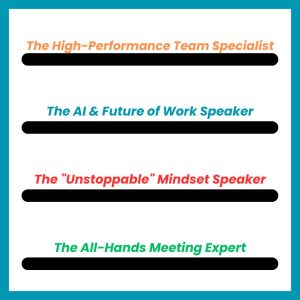 Choosing the right sales meeting speaker starts with matching the category to your team’s biggest gap. Here are the four types that deliver the most traction heading into 2026.
The High-Performance Team Specialist
This speaker focuses on culture, accountability, and collaboration — the foundation that determines whether a sales strategy actually sticks. They help teams move from individual producers to a unified, high-output unit. Best fit for: Organizations dealing with high turnover, siloed reps, or a culture reset after a difficult year.
The AI & Future of Work Speaker
According to The Lavin Agency, modern sales conferences are increasingly prioritizing practical AI and the future of work to stay competitive. This speaker cuts through the noise and shows your team exactly how to use emerging tools to prospect faster, personalize outreach, and close more deals. Best fit for: Teams that feel behind on technology or are struggling to integrate AI into their existing workflow.
The “Unstoppable” Mindset Speaker
Skills without psychology is a ceiling your team will hit every time. This speaker bridges the gap between what reps know and what they actually execute under pressure. They address the resistance behind pricing conversations and other common mental blocks that kill the pipeline. Best fit for: Teams with strong product knowledge but inconsistent performance.
The All-Hands Meeting Expert
Sales doesn’t happen in a vacuum. This speaker brings non-sales staff — marketing, ops, customer success — into the revenue mission. Alignment across departments removes friction and accelerates deal cycles. Best fit for: Companies preparing for a growth phase or launching a new go-to-market strategy.
The right category narrows the field fast. The next step is to find the speaker within that category who delivers more than just a great hour on stage.
Conclusion: Turning a Keynote into a Catalyst with Shawn Casemore
Motivation is the spark. Methodology is the fuel. The best sales speakers deliver both — and the data backs that up. Teams that walk away with repeatable skills and a reinforced mindset consistently outperform those that got a great afternoon and nothing else.
That’s exactly where Shawn’s approach to sales growth stands apart. His Unstoppable Sales™ framework equips teams with new skills and the mindset to sustain them — not just for the event, but across every quarter that follows. A single kickoff becomes a performance baseline the whole team can build on.
The difference between a forgettable keynote and a year of results comes down to one decision: choosing a speaker who treats your kickoff as a starting line, not a finish line.
Next Steps
Before your next sales kickoff, lock in these priorities:
- Define the outcome— revenue target, skill gap, or culture shift
- Match speaker category to your team’s biggest obstacle
- Confirm customization is part of the engagement, not an add-on
- Plan reinforcement so momentum extends past day one
Ready to stop guessing and start building? Book a consultation with Shawn Casemore and turn your next sales event into the catalyst your team’s been waiting for.
© Shawn Casemore 2026. All Rights Reserved.
Share This Article
Choose Your Platform: Facebook Twitter Google Plus Linkedin