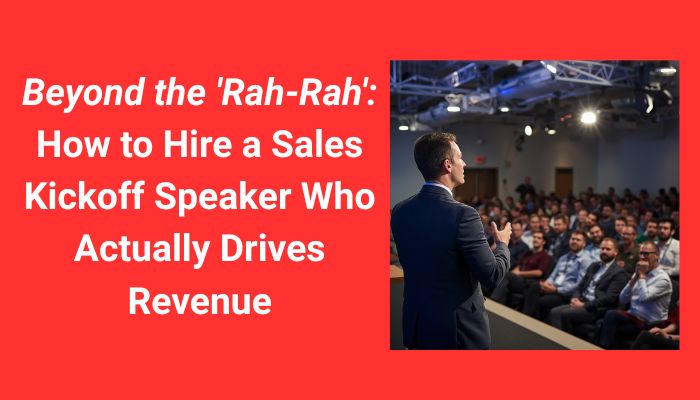
The SKO Paradox: Why Most Keynotes Fail to Move the Needle
Every sales kickoff starts with energy. The room is packed, the slides are polished, and reps leave fired up. Then Monday arrives. The inbox refills, quotas loom, and that motivational high fades faster than sunshine on a cloudy day.
This is the Monday Morning Problem — and it’s the reason most SKOs fail to generate measurable revenue impact. Motivation without a repeatable framework isn’t a strategy. It’s a sugar rush.
According to Richardson Sales Performance, 85% of sales training is forgotten within weeks if it isn’t reinforced by a compelling kickoff tied to ongoing execution.
The cost isn’t just wasted budget. It’s disengaged reps who’ve sat through one too many generic speeches, lost productivity during the post-event reset, and leadership wondering why the needle didn’t move — again.
The antidote isn’t a louder keynote. It’s a smarter one. The right sales kickoff speaker delivers a structured mindset shift — what separates average SKOs from ones that actually drive lasting behavior change is a framework reps can use the next morning and the month after.
That’s the core of an Unstoppable Sales approach: replacing rah-rah energy with repeatable execution habits. But getting there starts with understanding why bringing in an outside voice makes all the difference.
The Strategic Value of an External Sales Kickoff Speaker
You don’t need to bring in an outside speaker of course, but herein lies the problem. When insiders communicate sales strategy and tactics, reps filter it through politics, history, and skepticism. An outside voice carries none of that baggage.
According to Harvard Business Review, external speakers provide third-party validation that meaningfully increases rep buy-in for new corporate strategies. The message doesn’t change. The messenger does — and that changes everything.
The Credibility Gap Between Leadership and Reps
In practice, reps discount internal presentations. They’ve heard the “record year ahead” speech before. An external speaker steps outside that dynamic entirely. They’re not protecting a quota, defending a past decision, or softening feedback. That independence is what makes them credible.
This is especially important when leadership is rolling out new B2B sales strategies or shifting the team toward a new market motion. Reps are more likely to adopt what they genuinely believe, and belief starts with trust in the source.
From Inspiration to Execution
Engagement isn’t just a morale metric — it drives output. Gallup’s State of the American Workplace Report found that companies with highly engaged sales teams report 14% higher sales productivity. A skilled external speaker is one of the fastest levers to close the engagement gap.
A speaker doesn’t replace sales leadership — they amplify it, giving your strategy additional credibility and energy it needs to become ingrained in the culture.
The real question isn’t whether to bring in an outside voice. It’s about choosing the right one. That’s where most organizations get it wrong — and what the next section breaks down.
Motivation vs. Method: What to Look for in a Top Sales Speaker
Not every speaker who fires up a room actually changes behavior. The real differentiator is simple: does the speaker leave your team with a repeatable method, or just a memory?
As Gartner for Sales Leaders puts it, “The best sales kickoff speakers don’t just motivate; they provide a ‘mental model’ for how to solve the customer’s problem in a shifting market.” That distinction cuts through every conversation about sales kickoff meeting ideas you’ll have with your planning team. Energy is cheap. A framework your reps can use on a Tuesday afternoon call — that’s valuable.
Here’s a quick comparison to help you sort speakers before you ever get on a call with them:
| Speaker Type | Focus | Long-Term Impact |
| The Performer | Emotion, energy, inspiration | Fades within 2 weeks |
| The Storyteller | Narrative and relatability | Builds culture, limited tactical lift |
| The Practitioner | Repeatable method + mindset shift | Drives measurable behavior change |
You’re hiring for the third row.
The 5-Question Vetting Checklist
Before you book anyone, run them through these five questions:
- Do they customize? A canned speech that ignores your market, your buyer, and your current challenges is a wasted stage slot. Ask for evidence that they’ve tailored content for similar industries.
- Can they explain their mental model in one sentence? If they can’t, your reps won’t be able to either.
- Do they address mindset, skills, and strategy together? Weak speakers pick one. Strong speakers connect all three — a model sometimes called the “Unstoppable” framework. For complex B2B environments, all three elements are non-negotiable.
- What do past clients measure after the event? Testimonials about “energy” are a yellow flag. Pipeline metrics are a green one.
- Do they offer post-event reinforcement? One keynote doesn’t rewire behavior. Ask what happens after the applause stops.
The right speaker gives your team a lens, not just a lift. That narrows the field considerably — and the next section breaks down exactly which speaker categories are worth your attention heading into 2026.
Best All-Hands Sales Meeting Speakers: Categories for 2026
Picking a speaker gets easier when you stop thinking “who’s motivational?” and start thinking “what problem am I solving?” Three speaker categories consistently align with the annual sales meeting themes that drive real behavior change — and each one targets a different gap on your team.
The Transformational Expert
This speaker solves the execution problem. They break down complex sales cycles, modern buyer journeys, and the specific moments where deals stall. Top-ranked speakers like Mark Hunter, Jeb Blount and myself (Shawn Casemore) focus on specific tactical shifts rather than generic inspiration — your team leaves with a repeatable process, not a mood.
Example archetypes: The enterprise sales strategist who teaches multi-threaded deal management. The B2B pipeline coach who rebuilds prospecting cadences from scratch.
The Mindset Architect
This speaker targets identity. The goal is shifting your team from order takers to genuine problem solvers who own the outcome. In practice, the biggest shift isn’t skill — it’s the story reps tell themselves when a prospect pushes back. Developing an action-oriented sales approach is what separates teams who grind through Q1 from those who stall.
Example archetypes: The consultative selling expert who reframes value conversations. The growth-mindset coach who dismantles fixed thinking about quotas.
The Resilience Coach
Market volatility, lost deals, difficult prospects — this speaker helps teams burn through excuses and stay sharp when conditions get hard. The best resilience speakers don’t coddle; they install mental frameworks that hold up in real selling situations.
Example archetypes: The adversity keynote speaker with direct sales experience. The high-performance coach who translates athletic mental toughness into sales behavior.
Once you’ve identified the right category, the next challenge is ensuring that the speaker’s impact lasts beyond the main stage.
Integrating the Speaker into Your Annual Sales Meeting Themes
Booking the right speaker is step one. Getting full value from that investment means weaving them into your event before, during, and after the stage moment.
According to Sales Performance International, successful SKOs use themes that align with the speaker’s core framework to ensure a unified message. That alignment doesn’t happen by accident — it’s a design choice.
4 Integration Best Practices
 Pre-event engagement. Send a short video message or challenge from your speaker two weeks out. It builds anticipation and primes your team on the core concepts before day one.
- Theme alignment. Match your annual kickoff theme directly to the speaker’s framework. When the theme and the talk reinforce each other, the message lands harder — and sticks longer.
- Workshop integration. Move from the stage to the breakout room. The best speakers offer post-keynote workshops where reps apply the methodology to real deals. That’s where behavior actually shifts.
- Post-event reinforcement. A 12-month calendar keeps the message alive. Monthly micro-content, manager talking points, and quarterly check-ins tied to the speaker’s framework are all solid sales-enablement best practices that extend the ROI far beyond the event itself.
Pro-Tip: Provide your speaker with three real customer objections your team faces right now. A great speaker adapts the material to your reality — not the other way around. For extra context, share proven strategies for tough conversations so the messaging stays grounded in actual field challenges.
Done right, integration turns a single keynote into a full-year growth initiative — which is exactly the kind of culture shift worth building on.
Conclusion: Building an Unstoppable Sales Culture
A good all-hands sales meeting fires people up for a week. A transformative one reshapes how your team sells for the entire year. The difference isn’t the catering budget or the venue — it’s the quality and depth of the speaker you put on stage.
The market has shifted. Buyers are more informed, more skeptical, and slower to commit. Generic motivational content won’t move the needle. What works now is a speaker who brings a repeatable framework that your team can execute the moment they’re back on the phone. That’s the foundation of Shawn Casemore’s Unstoppable Sales™ approach — built specifically for teams navigating today’s complex selling environment. You can start by diagnosing where your team stands before you even book the room.
The right speaker isn’t the loudest one. They’re the one your team is still quoting in Q3.
When you vet your next speaker, demand depth over volume. Ask for proof of behavior change, not just applause. Then explore what drives consistent revenue growth and build your event around that outcome.
© Shawn Casemore 2026. All Rights Reserved.
Share This Article
Choose Your Platform: Facebook Twitter Google Plus Linkedin