The Sales Training Paradox: Why ‘Great’ Sales Training Programs Yield Mediocre Results
Companies collectively spend over $70 billion annually on sales training programs — and the majority have almost nothing to show for it. Not because the content was poor, nor because the trainers lacked talent. The real issue is that these programs were never designed to change behavior.
It’s almost like sales theater rather than sales training. Reps leave fired up for change, managers feel excited for the impacts to be achieved, and leadership checks the “we invested in our team” box. Six weeks later? Pipelines look identical. Close rates haven’t budged. Exercise notes sit untouched in a drawer.
“Practice is just as valuable as a sale. The sale will make you a living; the skill will make you a fortune.” — Jim Rohn
The hard truth is that most organizations are measuring the wrong thing. They evaluate training by attendee satisfaction scores and facilitator energy — not by whether reps actually changed how they sell on Monday morning.
Execution is the only metric that matters.
Understanding why the execution gap exists — and specifically what happens inside a salesperson’s brain in the weeks after training — is where the real problem reveals itself.
The Reality of Skill Decay
Here’s a number that should make every sales leader pause: The Forgetting Curve, first introduced by Hermann Ebbinghaus (1885), suggests that humans forget roughly 50%–90% of new information within days or weeks, with the steepest decline occurring shortly after learning.
That’s not a rounding error — it’s a near-total collapse of your training investment.
“Training without reinforcement isn’t a program — it’s an expensive forgetting exercise.”
The root cause is straightforward neuroscience. The brain doesn’t retain information it doesn’t repeatedly use. A three-day sales bootcamp for example, however brilliantly designed, is still a single event. The moment reps return to their territories, competing priorities, live deals, and daily noise begin overwriting what they learned.
Several factors accelerate this knowledge retention gap:
- No immediate application— Skills learned in a classroom setting aren’t practiced in real deal contexts within days of training
- Absence of application coaching— Managers don’t consistently observe and correct behavior in the field
- Lack of accountability loops— Without follow-up checkpoints, reps have little motivation to self-reinforce
The distinction between event-based and process-based learning is critical here. Events create awareness. Processes create behavior change. When memory failure becomes the norm, it doesn’t stay a training problem — it becomes an execution failure that quietly undermines every deal in your pipeline.
That gap between knowing a methodology and actually applying it under pressure? That’s exactly where the execution gap exists — and closing it requires more than better slide decks.
Mind the Execution Gap: Visibility vs. Behavior Change in Sales and Training
Understanding why training doesn’t stick is only half the battle. The other half is recognizing where the breakdown actually happens — and it’s not where most sales leaders assume.
You can see the problem clearly on a dashboard, yet still watch it worsen in the field.
| Visibility Metrics | Execution Adjustment |
| CRM data shows low close rates | Rep needs to change how they handle objections |
| Call recordings flag weak discovery | Rep needs to ask more in-depth questions |
| Pipeline reports reveal stalled deals | Rep needs to apply a consistent re-engagement strategy |
| Coaching notes document skill gaps | Rep must demonstrate new behavior under pressure |
The left column is where most organizations live. The right column is where revenue actually happens.
The Dashboard Illusion
Modern sales training technology has made diagnosing performance gaps almost effortless. AI tools can surface patterns across hundreds of calls in minutes.
The problem? Diagnosis is not development. Knowing a rep struggles with value positioning doesn’t automatically give them the muscle memory to pivot confidently mid-conversation.
The ‘Paper vs. Field’ Problem
Methodologies look elegant in slide decks. They fall apart when a prospect throws an unexpected curveball. What typically happens is that reps default to comfortable habits and behaviors — not the framework they were trained on — because that framework was never reinforced deeply enough to become instinctive.
Design Isn’t the Culprit
Most sales enablement programs fail not because they’re poorly designed, but because execution stops the moment the training room empties. The investment goes into the curriculum; the gap lives in the daily rep workflow.
Closing that gap requires a fundamentally different approach — one built around focused, repeatable practice rather than broad knowledge delivery.
The 3-3-3 Rule: A Tactical Framework for Sales Mastery
Now that we’ve identified where the execution gap exists, the next logical question is: what actually closes it? One practical framework gaining traction across sales training programs teams use to drive retention is the 3-3-3 rule — a focused, repeatable structure designed to replace broad skill exposure with genuine behavioral change.
The premise is straightforward: instead of overwhelming reps with a dozen competencies at once, the 3-3-3 rule narrows execution down to what’s actually manageable.
Here’s how it breaks down:
- 3 Key Skills— Identify the three highest-impact behaviors your team needs to develop right now. Not ten. Not five. Three. Prioritization forces discipline and creates clarity for both reps and their managers.
 3 Months of Focus— Commit to those same skills for a full quarter. Skill mastery doesn’t happen in a two-day workshop; it requires sustained, deliberate practice over time. Three months provide enough runway to move from awareness to automatic execution.
- 3 Coaching Touch-points— Structured, consistent reinforcement keeps skills front-of-mind. These don’t need to be lengthy — a 10-minute call review counts. What matters is frequency, not duration.
“The most dangerous training assumption is that exposure equals adoption. Narrowing focus is what separates teams that remember training from teams that actually use it.”
There’s also a psychological dimension worth noting. In practice, smaller, repeatable wins build the kind of confidence that compounds. When reps see measurable improvement in three defined areas, momentum follows naturally — and resistant attitudes toward training tend to soften.
Which raises a critical question: who’s responsible for maintaining those coaching touchpoints? The answer points directly to sales managers — and that’s exactly where the next conversation needs to go.
The Coaching Multiplier: Why Application Coaching is the Real Training
Whether you subscribe to the 3-3-3 rule or note, it gives reps a repeatable structure for practice and reinforcement — but a framework only creates results when someone holds people accountable to it.
Gartner research shows that combining sales training with consistent coaching is four times more effective than training alone. Four times. That single data point re-frames the entire conversation about where training budgets should be allocated.
The Coach’s Role
There’s a critical difference between informal check-ins and dynamic, formal coaching. Informal coaching looks like a manager scanning a deal in the CRM and asking, “Where does this stand?” Formal coaching, on the other hand, is structured, scheduled, and tied directly to observable behaviors — call recordings, objection handling, pipeline progression. One is reactive. The other is developmental.
In practice, most managers default to informal coaching simply because formal processes require time and design. But that shortcut has a measurable cost.
The Feedback Loop
Managers who can translate performance insights — win/loss patterns, conversation analytics, pipeline trends — into specific, coachable moments are creating a feedback loop that no training event can replicate. The insight alone doesn’t change behavior. The conversation around the insight does.
This is why execution consistently breaks down even when teams have access to excellent data and tools. Knowledge sitting in a dashboard is inert without a coach to activate it.
The Win Rate Impact
CSO Insights found that organizations with formal, dynamic coaching processes see a 19% improvement in win rates. That’s not a marginal gain — it’s a structural competitive advantage.
Training builds potential. Coaching converts it into performance. Which raises the question: even with the right manager and the right framework, are your teams equipped to turn insights into execution-ready skills? That’s where facilitation becomes the critical last mile.
Why Sales Insights Don’t Improve Execution Without Facilitation
Data dashboards don’t close deals. Sellers do.
This distinction sits at the heart of every conversation about sales training effectiveness — and it’s where most programs quietly fall apart. You can arm a rep with CRM analytics, AI-generated call scores, and performance benchmarks, however knowing what to do and actually doing it under pressure are two entirely different capabilities.
This is the knowing-doing gap in plain language. A rep might understand that they talk too much during discovery. They might see it in their call data. But without a structured moment to practice the 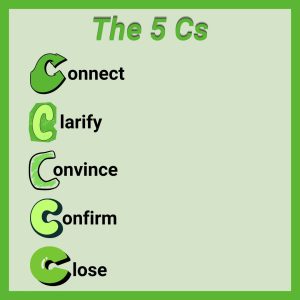 alternative — with feedback, repetition, and coaching — that awareness evaporates the moment a real prospect pushes back.
This is where the 5 Cs of sales — Connect, Clarify, Convince, Confirm, and Close — become more than a checklist. AI tools identify where breakdowns happen; coaching is the tool to implement the behavioral changes for effective improvement.
The most expensive training program in the world means nothing if execution never changes.
Key Sales Training Programs Takeaways
- No immediate application— Skills learned in a classroom setting aren’t practiced in real deal contexts within days of training
- Absence of coaching reinforcement— Managers don’t consistently observe and correct behavior in the field
- Event-based vs. process-based learning— A one-time workshop creates initial awareness; only continuous, spaced repetition builds durable skill
- No accountability loops— Without follow-up checkpoints, reps have little motivation to self-reinforce
“Practice is just as valuable as a sale. The sale will make you a living; the skill will make you a fortune.”
© Shawn Casemore 2026. All Rights Reserved.
Share This Article
Choose Your Platform: Facebook Twitter Google Plus Linkedin